

Hey there! As an aluminum coil supplier, I often get asked about the weight of a standard aluminum coil. It's a question that might seem simple at first glance, but there's actually quite a bit to unpack.
First off, let's talk about what makes up the weight of an aluminum coil. The weight mainly depends on a few key factors: the thickness of the aluminum, the width of the coil, and the length of the coil. Aluminum has a density of about 2.7 grams per cubic centimeter. This density is pretty consistent across different types of aluminum, but it's still the base we use to figure out the weight.
Let's start with the thickness. Thicker aluminum obviously means more material, and thus, a heavier coil. For example, a coil that's 1 millimeter thick will weigh a lot more than one that's 0.5 millimeters thick, assuming the width and length are the same. The width also plays a big role. A wider coil has more surface area, which means more aluminum. And of course, the longer the coil, the more aluminum there is overall.
To calculate the weight of an aluminum coil, we use a simple formula. First, we need to find the volume of the aluminum in the coil. The volume (V) is calculated by multiplying the thickness (t), width (w), and length (l) of the coil. So, V = t x w x l. Once we have the volume, we multiply it by the density of aluminum (2.7 g/cm³) to get the weight.
Let's say we have a coil that's 1 millimeter thick, 1000 millimeters wide, and 10000 millimeters long. First, we need to convert all the measurements to centimeters. So, the thickness is 0.1 cm, the width is 100 cm, and the length is 1000 cm. Now, we calculate the volume: V = 0.1 cm x 100 cm x 1000 cm = 10000 cm³. Then, we multiply the volume by the density: 10000 cm³ x 2.7 g/cm³ = 27000 grams, or 27 kilograms.
But in the real world, things aren't always that straightforward. There are different types of aluminum coils, and they can have different weights even if they have the same dimensions. For example, Color Aluminium Coil often has a coating on it. This coating adds a little bit of weight to the coil. The coating can be made of different materials, and each material has its own density. So, a color aluminum coil might weigh a bit more than a plain aluminum coil of the same size.
Another type is Pre Coated Aluminium. This is aluminum that has been pre-coated with a layer of paint or other protective material. Again, this coating adds to the weight. The thickness and type of the coating can vary, so the weight increase can also vary.
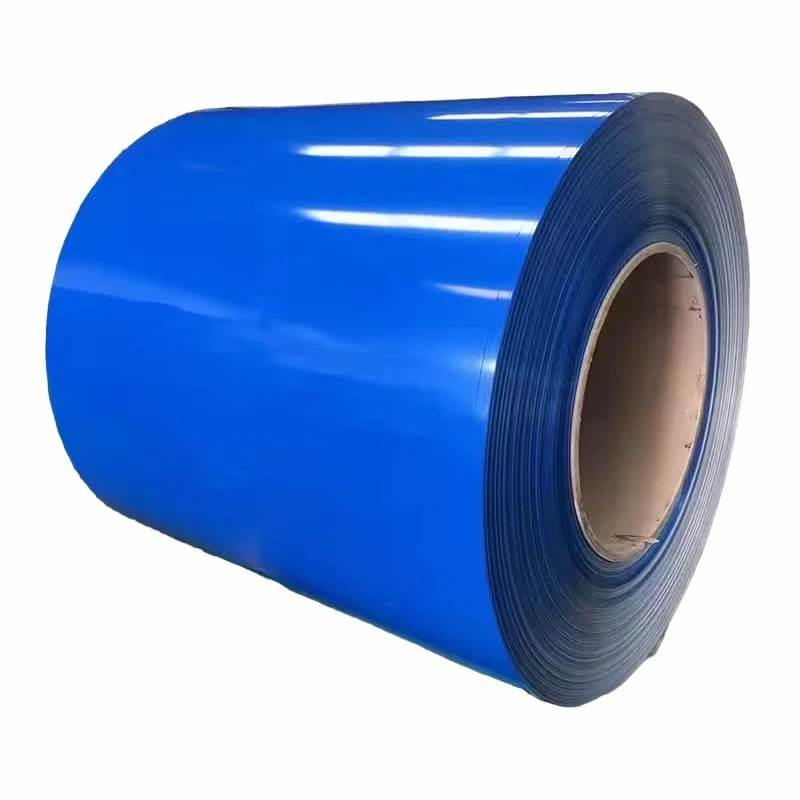

Prefinished Aluminum Coils are also popular. These coils are finished with a special treatment that gives them a smooth and durable surface. Like the other coated coils, the finishing process adds some weight.
When it comes to shipping and handling, the weight of the aluminum coil is a crucial factor. Heavier coils are more expensive to ship, and they might require special equipment to handle. That's why it's important for us, as suppliers, to accurately calculate the weight of the coils we're selling. It helps our customers plan their budgets and logistics.
We also need to consider the weight when it comes to storage. Heavier coils take up more space and might require stronger storage racks. If a customer is planning to store a large number of coils, they need to make sure their storage facilities can handle the weight.
In addition to the physical weight, we also need to think about the practical weight. For example, if a customer is using the aluminum coil for a construction project, they need to make sure the structure can support the weight of the coil. If the coil is too heavy, it could cause problems with the stability of the structure.
As an aluminum coil supplier, we're always here to help our customers figure out the right weight for their needs. Whether you're looking for a lightweight coil for a small project or a heavy-duty coil for a large construction job, we can provide you with the information you need.
If you're interested in purchasing aluminum coils, we'd love to have a chat with you. We can discuss your specific requirements, including the weight, dimensions, and type of coil you need. We can also provide you with a quote based on your needs. So, don't hesitate to reach out to us if you have any questions or if you're ready to start your order.
In conclusion, the weight of a standard aluminum coil depends on several factors, including the thickness, width, length, and any coatings or finishes. By understanding these factors, you can make an informed decision when it comes to purchasing aluminum coils. And remember, we're here to support you every step of the way.
References
- Aluminum Handbook: A Comprehensive Guide to Aluminum Properties and Applications
- Industry Standards for Aluminum Coil Manufacturing and Quality Control